
Here’s something that might surprise you: when swimmers start slowing down in training, many think that it is a fitness problem. But fitness is rarely the real culprit. What’s actually happening is something a lot more interesting — the brain and body are losing their ability to talk to each other properly.
Swimming isn’t just about how hard you can push. It’s a coordination puzzle. Your timing, breathing, body position, and stroke all have to work together as one smooth package. When you’re tired or training isn’t structured well, that package starts to fall apart — and that’s when your speed drops, even if you still have plenty of energy left in the tank.
The brain works smarter, not harder
Research backs this up in a cool way. Elite swimmers don’t just have stronger bodies — their brains are actually more efficient. They use less mental energy to produce cleaner, smoother movement. But when fatigue hits or training gets sloppy, that efficiency breaks down. The nervous system starts working overtime just to keep basic movement together. The result? Messy timing, a blurry stroke, and slower times — even when the swimmer’s fitness is totally fine.
As expertise grows, the brain internalises the structure, and the swimmer no longer needs to consciously manage it. But that only happens if training gave the nervous system something structured to adapt to in the first place.
Rhythm is more powerful than you think
One of the most underrated tools in swimming is rhythm. A study on young freestyle swimmers found that rhythm training significantly improved their coordination. And it makes total sense — rhythm gives your nervous system something solid to hold onto when things get hard. It keeps your timing locked in and your movement organized, even when fatigue is trying to pull everything apart.
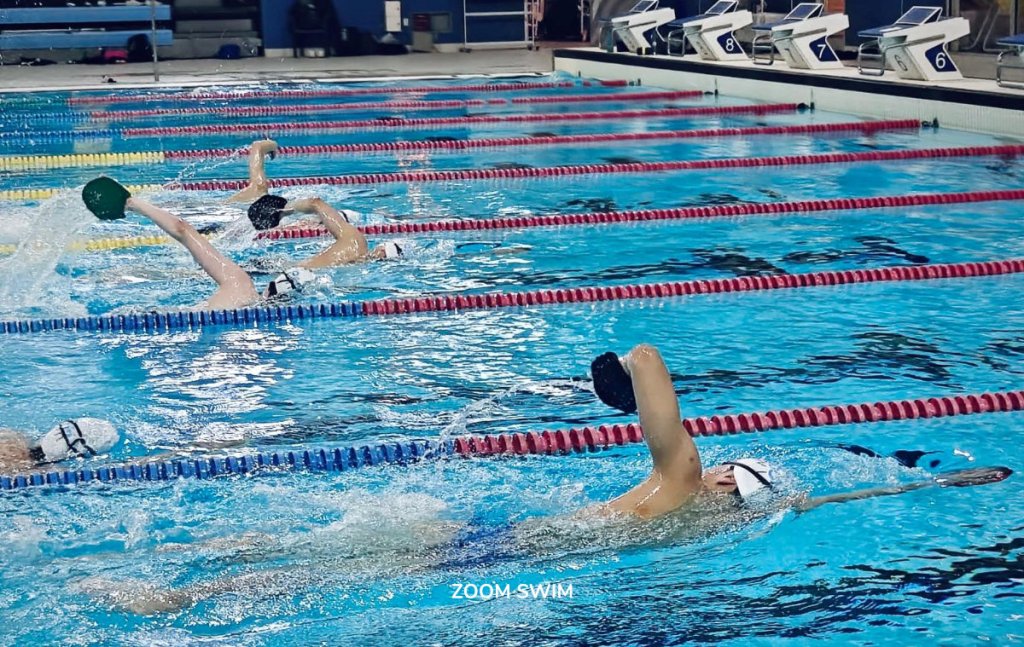
You’ve probably seen this happen in a set. At the start, everything looks great — smooth rotation, controlled breathing, everything clicking. Then, as tiredness builds, things start to unravel. Stroke rate shoots up but you’re not actually going faster. Breathing becomes frantic. The body is still moving, but it’s lost its structure.
The real problem with most swim training
If swimmers are just grinding through meters with no real focus on rhythm or race-specific demands, the brain adapts to a low-quality version of swimming. Swimmers get really good at surviving long sets — but not at holding their speed and form when it actually counts. That’s why so many swimmers look great in practice and then fall apart on race day.
So what should training actually look like?
A 2026 systematic review in Brain Sciences puts hard numbers behind this. Across 24 studies, elite swimmers showed significantly fewer unnecessary brain connections during complex tasks — their nervous systems run leaner, not louder. Most striking: brain connectivity between the relay centre and movement networks explained 41% of the variance in world ranking. Not fitness. Not stroke count. Brain connectivity. The gap between good and great isn’t just physical — it’s neural.
At Zoom Swim, the approach is straightforward: training isn’t about racking up distance. It’s about teaching the nervous system to stay organized under pressure.
- Sprint work is done with full recovery so speed is built on precision, not just pushing through exhaustion.
- Middle-distance work focuses on holding rhythm and coordination as tiredness builds.
- Aerobic work still has a technical standard — because sloppy meters just train sloppy swimming.
Rhythm isn’t just a nice extra — it’s a core tool. It’s what keeps your stroke together when your body wants to fall apart.
The bottom line
Fatigue isn’t the enemy. Unstructured fatigue is. Fatigue just reveals whether the nervous system has been trained well or not. If your coordination crumbles every time the going gets tough, that’s not a fitness problem — it’s a control problem.
Swimmers don’t slow down because they’re unfit. They slow down because their nervous system hasn’t been trained to stay organized under pressure. Once you start targeting that in training, performance stops feeling random — and starts becoming something you can count on every single time.

 Zoom Swim
Leave a comment